
He grew up with two hours of electricity a day. Now his fans save India billions in energy bills.
Manoj Meena and Sibabrata Das spent four years failing at IIT Bombay's incubator, drowning in debt, and refusing to quit — before they asked a question nobody in the Indian appliances industry had bothered with: why does a ceiling fan still use the same electricity it did in 1965? The answer became Atomberg. ₹1,000 crore in revenue. $119M raised. India's No. 1 BLDC fan brand. IPO 2026.
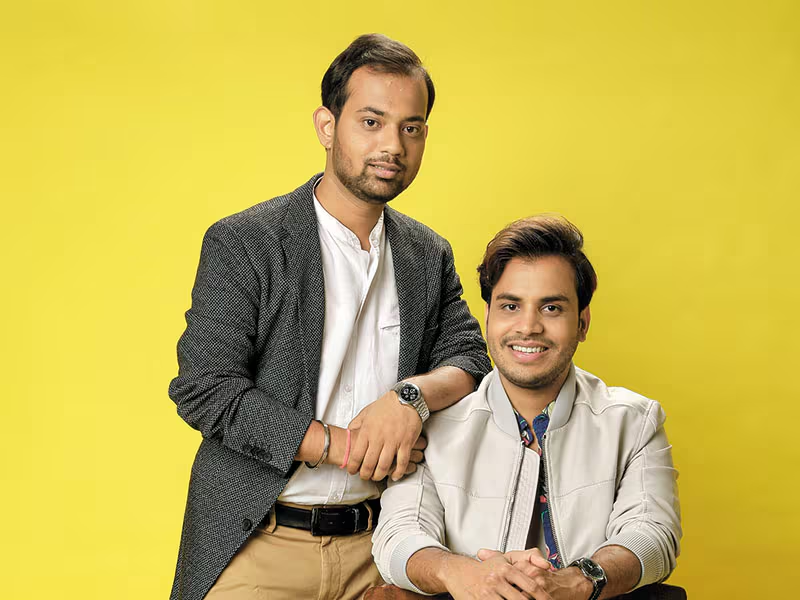
Manoj Meena & Sibabrata Das
Co-Founders · Atomberg Technologies
Two Hours of Electricity, a Lifetime of Obsession
Manoj Meena grew up in Dausa, a small town in Rajasthan, where the electricity grid delivered just one or two hours of power each day. His farmer family ran the motor to pump water, charged appliances, got their work done — and then the town went dark. That childhood didn't make Manoj pessimistic. It made him precise. Every watt of power was worth something. Waste was not an option.
After graduating from IIT Bombay with a dual degree in Electrical Engineering, Manoj channelled that precision into robotics, algorithms, and motor control systems. He started Atomberg in 2012 at IIT Bombay's SINE incubator — not with a fully-formed idea, but with a refusal to accept that ceiling fans in 2012 consumed the same amount of power they did in 1965.
Sibabrata Das, his eventual co-founder, had his own story of persistence. After IIT Bombay, he tried silk export from Assam to Dubai, then an online cosmetics marketplace. Both failed. "The world looked at them as if they were failures," wrote one account. "Their mentors, friends and seniors advised them to quit." They didn't.
Four Years, Four Failures, Then the Fan That Clicked
From 2012 to 2015, Atomberg tried and failed with multiple ideas — a vehicle tracking system, consulting projects, industrial automation. The consulting work kept them alive but never built a company. What it built was something more valuable: deep expertise in motor control, power electronics, and embedded systems.
In 2014, Manoj and Sibabrata put that knowledge to a new question: why do ceiling fans still consume 70–75 watts when BLDC motor technology existed that could do the same job on 28 watts? The answer wasn't a technical gap. It was a commercial one. Nobody had bothered.
After 10–15 prototypes, they launched the Gorilla Efficio — India's first BLDC motor ceiling fan — in April 2015. Within weeks, 1,500 pre-orders arrived. Manoj Meena, who had spent four years accumulating debt while being told to quit, had his first win. "Armed with this win, his first in 4 years, a buoyant Manoj went to meet potential investors." The investors still said no. The founders self-funded the first manufacturing unit in Navi Mumbai anyway.
₹1,000 Crore and the Road to IPO
Atomberg's go-to-market was unusual for a consumer brand: it started in B2B. Ceramic factories — with their dust, heat, voltage fluctuations, and 24/7 operations — became the proving ground. If a BLDC fan could survive there and deliver measurable savings, it would generate the case studies needed to build consumer trust. It did. The company then pivoted to consumers — first online, then offline.
Today, Atomberg sells 1 million+ fans per year. Its products are the highest-rated ceiling fans on Amazon and Flipkart. It has 2,000+ authorised dealers, 3,000+ daily service transactions, and 99% pin code coverage across India. Revenue reached ₹958.4 crore in FY25 and crossed ₹1,000 crore — a milestone Sibabrata Das announced on LinkedIn.
Beyond fans, Atomberg has expanded into mixer grinders (BLDC motors, 40% quieter than conventional), smart locks, cold press juicers, and the Intellon — India's first adaptive water purifier. A $119M total funding journey culminated in December 2025 with a $24M extension. The IPO — targeting ~₹2,000 crore — is planned for FY2026. The kid from Dausa who grew up with two hours of electricity is building India's most energy-efficient home.
"Atomberg is an engineering-led product-first company focused on solving latent consumer problems. Our proprietary tech stack is at the core of every product."
— Manoj Meena, Co-Founder & CEO, Atomberg Technologies
Company Timeline
- 2012
Manoj Meena incubates Atomberg at SINE, IIT Bombay. Sibabrata Das — after two failed startups — joins as co-founder. The team begins doing tech consulting for DRDO, BARC, and IITs to survive, building expertise in motor control systems.
- 2012–14
Three more ideas fail. Neck-deep in debt, advised by mentors to quit. Manoj and Sibabrata stay. They study industrial motors and discover that BLDC technology can make ceiling fans 60–65% more energy-efficient — a 50-year-old problem no one had solved.
- Apr 2015
After 10–15 prototypes, the Gorilla Efficio BLDC fan is ready. 1,500 pre-orders validate product-market fit. Atomberg raises ₹1 crore angel funding. A production facility is set up at Navi Mumbai.
- 2016–18
B2B strategy validates technology in harsh environments — ceramic factories, textile plants. Case studies prove energy savings. Company pivots to consumer market. Revenue breaks ₹1 crore per month from e-commerce.
- 2019–21
Smart IoT-compatible fans launched. WWF and UNIDO awards won. National Entrepreneurship Award from Government of India. Highest-rated fans on Amazon and Flipkart. Customers include Reliance, Infosys, Tata, IIT, IIIT-H.
- 2023
$86M Series C raised, led by Temasek and Steadview Capital. Revenue crosses ₹645 crore (FY23). Expansion into mixer grinders and smart locks. Company now produces 1 million+ fans per year across 60+ Indian cities.
- Dec 2025
$24M Series C extension led by Temasek. Total funding: $119M. FY25 revenue ₹958.4 crore — ₹1,000 crore milestone crossed. Net losses narrow 41% to ₹117.4 crore. IPO planned for FY2026 to raise ~₹2,000 crore.
Frequently Asked Questions
Who are the founders of Atomberg and what is their background?
Atomberg was co-founded in 2012 by Manoj Meena (CEO) and Sibabrata Das (COO), both IIT Bombay graduates. Manoj grew up in Dausa, Rajasthan, with only 1–2 hours of daily electricity — which shaped his mission of energy efficiency. Both founders had multiple failed ventures before discovering the BLDC fan opportunity, and were incubated at SINE, IIT Bombay.
How is Atomberg's BLDC fan different from regular fans?
Atomberg's BLDC (Brushless DC) fans consume 28 watts versus 70–75 watts for conventional fans — a 60–65% energy reduction. They run 3x longer on inverter backup during power cuts, are remote and IoT-compatible, have no carbon brushes to wear out, and are significantly quieter. A household can save 200–250 electrical units per fan per year, often recovering the price premium within 12–18 months.
Is Atomberg profitable?
Atomberg remains loss-making but is rapidly narrowing losses. Net loss fell 41% from ₹199 crore in FY24 to ₹117.4 crore in FY25, on revenue of ₹958.4 crore. EBITDA margin improved to -6.62%. The company is on a clear path to profitability as scale increases and marketing spend efficiency improves post-IPO.
What is Atomberg's IPO plan?
Atomberg is targeting an IPO in Q1 FY2026–27 (April–June 2026) aiming to raise approximately ₹2,000 crore (~$200 million). Avendus Capital and IIFL are expected to manage the issue. The offering will include a mix of fresh share issuance and secondary sale by existing investors including Temasek and Steadview Capital.